
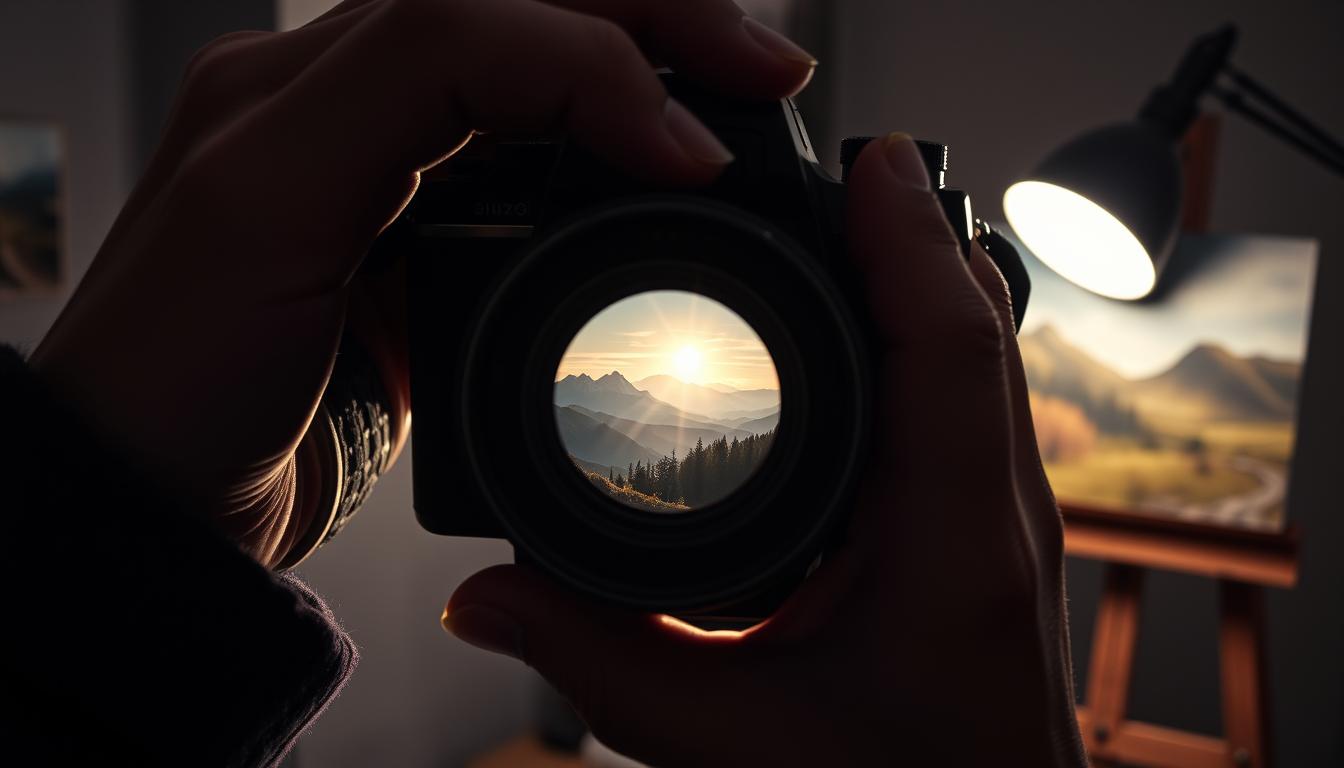
Did you know that creative hobbies like photography can boost your mental health? Photography is a special way to express yourself and grow personally. It falls under the visual arts category.
Exploring photography can change your life. It helps you live more mindfully and discover yourself. You can share your stories and photos with us. We’ll feature them on our platform, just like a photo series that tells a story.
By taking up photography as a creative hobby, you’ll see the world in new ways. It makes your life richer and more fulfilling.
Key Takeaways
- Photography enhances mental well-being through creative expression.
- It fosters personal growth and mindful living.
- Sharing your photos and stories can be a powerful form of self-expression.
- Engaging in visual arts can lead to new experiences and perspectives.
- Photography is a transformative creative pursuit.
The Art of Photography: A Beginner’s Guide
Photography is more than just taking pictures. It’s about telling a story in one frame. Beginners need to learn the basics to grow creatively.
Let’s look at the basics for a strong photography foundation. Composition, gear, and lighting are key. Each plays a big role in telling your story.
Understanding Composition Basics
Composition is photography’s backbone. It guides the viewer’s eye. The rule of thirds is a key principle.
For landscapes, place the horizon on a third line. This makes the image balanced and engaging. Trying different compositions helps you find your style and express yourself.
| Composition Technique | Description | Example |
|---|---|---|
| Rule of Thirds | Dividing the frame into thirds both horizontally and vertically | Placing a subject along the lines or at their intersections |
| Symmetry | Using symmetry to create a sense of order | Capturing reflections or patterns |
| Leading Lines | Guiding the viewer’s eye through the image | Using roads, paths, or shorelines to lead to the subject |
Essential Gear for New Photographers
Right gear is important, but not the most expensive. Start with a DSLR or mirrorless camera and a versatile lens, like an 18-55mm lens.
A tripod is also a good investment. It helps with sharper images in low light. Try different filters to change your photo’s mood.
“The camera is an instrument that teaches people how to see without a camera.” – Dorothea Lange
The Role of Lighting in Photography
Lighting is crucial in photography. It changes the mood of your images. Natural light is often the best, especially during the golden hour.
Learning to work with light improves your photos. Using natural light can be therapeutic, encouraging you to see the world differently.
For more on photography and its benefits, visit https://livelearncreate.blog/blog/.
Exploring Different Photography Styles
Exploring different photography styles can really boost your creativity and skills. As you grow, you’ll see that each style has its own way to express you and show the world. It’s a journey that can change how you see things.
 and a [50mm f/1.8 lens](https://www.amazon.com/Nikon-NIKKOR-50mm-Prime-Lens/dp/B00X8MRBCW/) to create a soft, natural-looking image with beautiful bokeh. In the middle ground, an adventurous landscape photographer capturing the grandeur of a majestic mountain range using a [Sony A7R IV Mirrorless Camera](https://www.amazon.com/Sony-Mirrorless-Digital-Camera-Body/dp/B07X6L9RVJ/) and a [16-35mm f/2.8 GM lens](https://www.amazon.com/Sony-FE-16-35mm-F2-8-Lens/dp/B01M1XQXAD/), harnessing the dramatic lighting and angles. In the background, a Live.Learn.Create brand ambassador experimenting with abstract double exposures on a [Fujifilm X-T4 Mirrorless Camera](https://www.amazon.com/Fujifilm-X-T4-Mirrorless-Camera-Body/dp/B085WKQZLJ/), creating a](https://livelearncreate.blog/wp-content/uploads/2025/08/Exploring-Different-Photography-Styles-A-vivid-array-of-photographic-genres-captured-with-1024x585.jpeg "Exploring Different Photography Styles: A vivid array of photographic genres captured with cinematic precision. In the foreground, a skilled portrait photographer using a [Nikon D850 DSLR Camera](https://www.amazon.com/Nikon-D850-Digital-Camera-Body/dp/B074MZXYL4/) and a [50mm f/1.8 lens](https://www.amazon.com/Nikon-NIKKOR-50mm-Prime-Lens/dp/B00X8MRBCW/) to create a soft, natural-looking image with beautiful bokeh. In the middle ground, an adventurous landscape photographer capturing the grandeur of a majestic mountain range using a [Sony A7R IV Mirrorless Camera](https://www.amazon.com/Sony-Mirrorless-Digital-Camera-Body/dp/B07X6L9RVJ/) and a [16-35mm f/2.8 GM lens](https://www.amazon.com/Sony-FE-16-35mm-F2-8-Lens/dp/B01M1XQXAD/), harnessing the dramatic lighting and angles. In the background, a Live.Learn.Create brand ambassador experimenting with abstract double exposures on a [Fujifilm X-T4 Mirrorless Camera](https://www.amazon.com/Fujifilm-X-T4-Mirrorless-Camera-Body/dp/B085WKQZLJ/), creating a")
Portrait Photography Techniques
Portrait photography is all about capturing your subject’s essence. Create a comfy atmosphere to let them relax and be themselves. Candid moments often reveal the true personality of the person you’re photographing. Try different angles and lighting to add depth to your portraits.
For example, natural light can make your portraits look soft and flattering. Studio lighting gives you more control. Remember, working with a photographer is like hanging out with a friend who has a camera. Building rapport is key.
Landscape Photography Essentials
Landscape photography is about showing the beauty of nature. To get good at it, you need to know composition basics. Use the rule of thirds and leading lines to improve your shots. Also, think about the time of day and weather to set the mood.
Shooting during the golden hour can add warmth and depth. Patience is important in landscape photography. Waiting for the right moment can make all the difference.
The Charm of Street Photography
Street photography captures the life and energy of public spaces. It’s about being observant and ready to snap at any time. Anticipating scenes and knowing your surroundings are key. It’s about telling stories through your images, freezing moments that show a place’s character.
Street photography is not just about technical skills. It’s about being engaged with the world. For more inspiration and guidance, check out https://livelearncreate.blog/blog/ for photography resources.
Mastering Camera Settings
To take full control of your photography, you need to understand camera settings. Knowing how to adjust these settings can improve your artistic expression. It lets you capture images that truly show your vision.
Shutter Speed and Its Impact
Shutter speed is key in photography. It controls how long the camera’s shutter is open. A fast shutter speed freezes moments, great for sports or wildlife photos. A slower shutter speed adds motion, making photos more dynamic.
Try different shutter speeds to get the effect you want. For example, a slow shutter speed can blur moving water or clouds. This adds artistic flair to your landscape photos.
Aperture and Depth of Field
Aperture is the camera’s aperture size, controlling light entry. A large aperture (small f-stop number) creates a shallow depth of field. This focuses the subject and blurs the background, perfect for portraits.
A small aperture (large f-stop number) increases depth of field. This keeps more of the image sharp, great for landscapes. You want both the foreground and background to be clear.
ISO Settings for Various Conditions
ISO settings affect how sensitive the camera is to light. Use a low ISO (like ISO 100) for bright days. A high ISO (like ISO 6400) is better for dark places. But high ISOs can add noise to your photos, so adjust wisely.
Knowing how to adjust ISO for different lighting can greatly improve your photos. For indoor or nighttime shots, increase the ISO. During the day, keep it low for clearer images.
Mastering these camera settings can boost your creative projects and unique style. Whether you’re a hobbyist or a pro, knowing your camera is crucial. It helps you capture stunning images that show your creative hobbies.
Editing Your Photos: Tips and Tools
Editing your photos can make a big difference. It can make your pictures more impactful and emotionally rich. As you learn more about photography, you’ll see that editing is key to perfecting your images and showing your creativity.
. Beside it, a pressure-sensitive drawing tablet [Wacom Intuos Pro](https://www.amazon.com/Wacom-Intuos-Creative-Pen-Tablet/dp/B07G1NNXTX) lies ready for precise edits. Soft, diffused lighting casts a warm glow, creating a professional yet inviting atmosphere. The Live.Learn.Create brand name subtly appears in the corner. This setup represents the essential tools for the modern photographer's digital darkroom.](https://livelearncreate.blog/wp-content/uploads/2025/08/Photo-editing-software-in-a-professional-studio-setting.-A-sleek-modern-desktop-computer-with--1024x585.jpeg "Photo editing software in a professional studio setting. A sleek, modern desktop computer with a high-resolution display showcases a popular photo editing application like [Adobe Photoshop](https://www.amazon.com/Adobe-Photoshop-Photography-Software-Subscription/dp/B07X6C9RMF). Beside it, a pressure-sensitive drawing tablet [Wacom Intuos Pro](https://www.amazon.com/Wacom-Intuos-Creative-Pen-Tablet/dp/B07G1NNXTX) lies ready for precise edits. Soft, diffused lighting casts a warm glow, creating a professional yet inviting atmosphere. The Live.Learn.Create brand name subtly appears in the corner. This setup represents the essential tools for the modern photographer's digital darkroom.")
Popular Editing Software Options
Choosing the right photo editing software is important. Adobe Lightroom and Photoshop are top choices. They have many tools to enhance your photos, from adjusting exposure and contrast to changing colors and textures.
If you’re new to editing, try free software like GIMP or Canva. They have easy-to-use interfaces and basic tools. These can help you improve your photos without needing to learn a lot.
Basic Editing Techniques for Beginners
Beginners should start with the basics. Adjusting exposure and contrast can greatly improve your photos. Cropping helps focus on your subject and remove distractions.
Understanding the histogram is also helpful. It shows the tonal values in your photo. This helps you make better exposure adjustments.
Advanced Editing for Professionals
For those with more experience, advanced techniques can elevate your photos. Using layers and masks in software like Adobe Photoshop allows for detailed edits. These edits can enhance specific parts of your image without affecting others.
Techniques like the ‘Orton effect’ can add a dreamy quality to your photos. Advanced noise reduction techniques can also make your images clearer, especially in low light.
For more on editing techniques and resources, visit https://livelearncreate.blog/blog/. This site has lots of info on creative activities, including visual arts and photography.
Finding Your Creative Voice
Exploring your unique side through photography is a creative pursuit that needs time and effort. As you keep going on your photography path, finding your own voice is key. It makes your work stand out and truly yours.
Developing a Photography Style
Finding your photography style is a personal adventure. It’s about trying new things, getting to know your gear, and seeing the world through your lens. Your style shows who you are and your creative choices.
To find your style, try these steps:
- Try different types of photography.
- Focus on lighting and how things are arranged.
- Look at other photographers for ideas.
Experimenting with Themes
Trying out themes is a great way to grow and challenge yourself. Themes can be about subjects, colors, or feelings. This helps you focus and can lead to new ideas and skills.
| Theme | Description | Creative Opportunities |
|---|---|---|
| Nature | Capturing landscapes, plants, and animals. | Macro photography, golden hour shots. |
| Urban | Focusing on city views and street life. | Architecture, street photography, night scenes. |
| Portrait | Highlighting people and their stories. | Studio lighting, candid shots, capturing expressions. |
The Importance of Personal Projects
Personal projects are crucial for your photography journey. They let you dive into topics you love, try new things, and show your vision. By working on personal projects, you get better and add to your creative exploration.
For more inspiration and tips, check out https://livelearncreate.blog/blog/. It has insights on creative pursuits and using photography as art therapy.
Building a Photography Portfolio
A well-curated photography portfolio showcases your skills and tells your creative journey. It’s essential for photographers aiming to make a mark in the visual arts.
![A professional photography portfolio displayed on a sleek, modern website with a clean, minimalist design. The portfolio features a grid layout showcasing a variety of stunning landscape, portrait, and lifestyle images, each with a subtle [Live.Learn.Create] watermark in the corner. The lighting is natural and well-balanced, captured using a high-quality [Canon EOS R6 Camera](https://www.amazon.com/Canon-Mirrorless-Camera-Body-Only/dp/B08KPGVSTF/) with a versatile [Canon RF 24-105mm F4 L IS USM Lens](https://www.amazon.com/Canon-24-105mm-USM-Lens-Black/dp/B07C23XGGY/). The overall mood is one of professionalism, creativity, and a passion for the art of photography.](https://livelearncreate.blog/wp-content/uploads/2025/08/A-professional-photography-portfolio-displayed-on-a-sleek-modern-website-with-a-clean-1024x585.jpeg "A professional photography portfolio displayed on a sleek, modern website with a clean, minimalist design. The portfolio features a grid layout showcasing a variety of stunning landscape, portrait, and lifestyle images, each with a subtle [Live.Learn.Create] watermark in the corner. The lighting is natural and well-balanced, captured using a high-quality [Canon EOS R6 Camera](https://www.amazon.com/Canon-Mirrorless-Camera-Body-Only/dp/B08KPGVSTF/) with a versatile [Canon RF 24-105mm F4 L IS USM Lens](https://www.amazon.com/Canon-24-105mm-USM-Lens-Black/dp/B07C23XGGY/). The overall mood is one of professionalism, creativity, and a passion for the art of photography.")
Selecting Your Best Work
Choosing your best photographs is the first step in building a strong portfolio. You need to review your work to find images that show your technical skills and creative vision. Quality is more important than quantity; a few standout images are more powerful than many average ones.
Think about the story you want to tell with your portfolio. Are you focusing on landscapes or portraits? Or do you want to show off your variety? The goal is to tell a cohesive story that shows your artistic voice.
Creating an Online Presence
In today’s digital world, having an online presence is key. Platforms like Instagram are great for showing your work to people all over the world. Being consistent is important; regular posts keep your audience interested.
“The camera is an instrument that teaches people how to see without a camera.” – Dorothea Lange
Having a professional website or blog can also boost your online presence. It lets you control how your portfolio is presented and connect with potential clients or collaborators.
Networking with Other Photographers
Networking with other photographers is very beneficial. Joining photography communities, online or in-person, offers chances for feedback, collaboration, and inspiration.
For more on building your photography portfolio and networking, visit https://livelearncreate.blog/blog/. Using platforms like Instagram can also help you connect with more people and keep up with photography trends.
The Business of Photography
To succeed in photography, you need to mix artistic expression with business skills. If you want to make a living from your passion, knowing the business side is key.
Pricing Strategies
Understanding how to price your work is essential for a photography business. You must figure out your costs, know the market, and set prices that show your value. A good pricing plan can attract the right clients and keep your business profitable.
- Research your competition to understand the market rate.
- Calculate your costs, including equipment, time, and overheads.
- Consider the value you offer to clients and price accordingly.
Marketing Your Photography Services
Marketing is crucial for growing your photography business. You need to know your audience, create a strong brand, and use the right channels to reach them. Activities like photography walks or workshops can attract new clients and grow your portfolio.
- Develop a strong online presence through your website and social media.
- Use SEO techniques to improve your visibility in search results.
- Network with other professionals and potential clients.
Building Client Relationships
Strong client relationships are vital for repeat business and referrals. It’s about providing great service, delivering quality work, and keeping in touch. By focusing on creative hobbies that your clients enjoy, you can build a loyal client base.
- Communicate clearly and promptly with clients.
- Deliver photos that exceed client expectations.
- Follow up with clients to ensure satisfaction and gather feedback.
For more tips on building a successful photography business, check out https://livelearncreate.blog/blog/. Companies like N. Lalor Photography LLC show the value of a strong online presence and engaging with clients.
Photography Challenges to Boost Creativity
Photography challenges are a great way to step out of your comfort zone. They help you explore new creative paths. By joining these challenges, you can boost your creativity, improve your skills, and find new ways to express yourself through photography.
, a [Manfrotto tripod](https://www.amazon.com/Manfrotto-MT055XPRO3-Aluminum-Tripod-MHXPRO-BHQ2/dp/B00G4M6BAC), a [Nikon 50mm f/1.8G lens](https://www.amazon.com/Nikon-50mm-1-8G-AF-S-Lens/dp/B004Y1AYAC), and a set of [Live.Learn.Create photography challenge cards](https://www.amazon.com/Live-Learn-Create-Photography-Challenges/dp/B08QZSJ7RT) scattered across a textured, moody backdrop. The scene is bathed in warm, directional lighting, casting dramatic shadows and highlighting the textures of the various elements. The overall atmosphere conveys a sense of creativity, inspiration, and the joy of photography.](https://livelearncreate.blog/wp-content/uploads/2025/08/A-captivating-still-life-composition-showcasing-an-assortment-of-photography-tools-and-1024x585.jpeg "A captivating still life composition showcasing an assortment of photography tools and equipment, including a [Sony Alpha a7III camera](https://www.amazon.com/Sony-Alpha-a7III-Mirrorless-Camera/dp/B07B43WPVK), a [Manfrotto tripod](https://www.amazon.com/Manfrotto-MT055XPRO3-Aluminum-Tripod-MHXPRO-BHQ2/dp/B00G4M6BAC), a [Nikon 50mm f/1.8G lens](https://www.amazon.com/Nikon-50mm-1-8G-AF-S-Lens/dp/B004Y1AYAC), and a set of [Live.Learn.Create photography challenge cards](https://www.amazon.com/Live-Learn-Create-Photography-Challenges/dp/B08QZSJ7RT) scattered across a textured, moody backdrop. The scene is bathed in warm, directional lighting, casting dramatic shadows and highlighting the textures of the various elements. The overall atmosphere conveys a sense of creativity, inspiration, and the joy of photography.")
Engaging in 30-Day Photo Challenges
30-day photo challenges are a popular way to spark your creativity. They ask you to take a photo every day on a specific theme. This keeps you motivated and focused. For example, you might take a photo of a different color each day or focus on textures.
To make the most of a 30-day challenge, remember to:
- Choose a theme that excites you
- Make time each day for photography
- Share your photos on social media to stay on track
Photography expert says, “Daily photo challenges can greatly improve your observation skills and help you see the world in new ways.”
Collaborating with Other Creatives
Working with other photographers or creatives can really boost your creativity. You can share ideas, learn new techniques, and gain insights into your photography. This collaboration can lead to exciting projects and new perspectives.
| Benefits of Collaboration | How to Collaborate |
|---|---|
| Get new ideas and perspectives | Join online photography communities or forums |
| Learn from others’ experiences and techniques | Attend workshops or photography meetups |
| Expand your portfolio with diverse projects | Work with models, makeup artists, or stylists on a photoshoot |
Exploring Unconventional Subjects
Trying out unusual subjects is another great way to boost your creativity. Instead of the usual landscapes or portraits, try capturing things like:
- Macro shots of everyday objects
- Abandoned or decaying structures
- Unusual textures or patterns
For more inspiration and guidance on photography challenges, check out https://livelearncreate.blog/blog/. It has lots of resources and ideas to help you.
By taking on photography challenges, you can reignite your passion for photography. You’ll develop your creative voice and produce work that truly shows your unique perspective.
The Role of Social Media in Photography
Social media has changed how photographers share their creative projects and artistic expression. It has opened new ways for photographers to show their work, connect with others, and find new clients.
Platforms to Showcase Your Work
Each social media platform has its own strengths for photography. For example, Instagram is great for sharing photos, while Facebook is better for detailed discussions and creating groups.
- Instagram: Ideal for visual storytelling and sharing behind-the-scenes content through Instagram Stories.
- 500px: A place where photographers can share their work and get feedback from others.
- Flickr: A dedicated space for photographers to share and discuss their work.
| Platform | Best For | Unique Feature |
|---|---|---|
| Visual Storytelling | Instagram Stories | |
| 500px | Community Feedback | Photo Critique |
| Flickr | Photography Community | Albums and Galleries |
Engaging with a Photography Community
Being part of a photography community on social media can boost your visibility. Join discussions, give feedback, and work with other photographers to grow your network.
- Join photography groups on Facebook and LinkedIn.
- Take part in challenges and contests on Instagram.
- Share your knowledge and experiences through blog posts or YouTube tutorials.
Using Hashtags Effectively
Hashtags are key on platforms like Instagram and Twitter. They help more people find your work. Find and use relevant hashtags in your field to reach more people.
- Use a mix of popular and niche-specific hashtags.
- Create a unique hashtag for your photography brand.
- Keep an eye on how your hashtags perform and adjust your strategy.
For more tips on using social media for photography, check out https://livelearncreate.blog/blog/.
Staying Inspired as a Photographer
Photographers need to keep their spark alive to grow and express themselves. Trying out different hobbies can bring fresh ideas and views.
Sources of Inspiration
Getting inspired by art and nature is very rewarding. Visiting museums or exploring outdoors can spark your creativity. It can also shape your photography style.
Staying Current
It’s important to keep up with photography trends. Following leaders and learning about new methods and tools keeps you ahead.
Learning Opportunities
Workshops and exhibitions are great for learning and networking. They offer chances to see new things and meet others who share your passion.
For more tips on keeping your creativity alive, check out https://livelearncreate.blog/blog/. It has advice on personal growth and creative development.
FAQ
What are the foundational elements of photography that I should start with?
To start your photography journey, learn about composition, gear, and lighting. These basics will help you tell stories and capture meaningful images. They are key to creative activities.
How can I develop my unique voice in photography?
Try different styles like portrait, landscape, and street photography. This will help you find your unique voice. Also, experiment with themes and personal projects to grow creatively.
What camera settings should I understand to take control of my photography?
Mastering shutter speed, aperture, and ISO is crucial. These settings greatly affect your photos. They help you achieve the look you want in your visual arts.
How can I refine my images through editing?
Use editing software to improve your photos. Techniques like the ‘Orton effect’ can add a dreamy touch to your work. This allows for more creative pursuits.
How do I build a portfolio to showcase my photography work?
Choose your best photos and create an online portfolio. Network with other photographers. This will help you grow your audience and share your art.
What are some ways to stay inspired as a photographer?
Find inspiration in art and nature. Stay updated with trends. Attend workshops and exhibitions. These steps will keep you inspired and help you grow as a photographer.
How can I turn my passion for photography into a profession?
Learn the business side of photography. Understand pricing, marketing, and client relationships. This knowledge is key to turning your passion into a career and showcasing your work.
What role does social media play in modern photography?
Social media is a great way to show your work. It helps you connect with others and increase your visibility. Use hashtags to share your projects with more people.
How can photography challenges boost my creativity?
Try 30-day photo challenges and collaborate with others. Explore new subjects to keep your photography exciting. This will help you grow creatively and find new ways to express yourself.
Transform your home into a more peaceful and mindful sanctuary. Creating a Zen-inspired home environment is a core part of the “Live.Learn.Create” theme, focusing on peace, mindfulness, and a clutter-free space. Here is a curated list of Zen home items.
The Zen Essentials
These items are the building blocks of a calm, intentional living space.
- Candles & Scents:
- Scented Candles: Look for calming, natural scents like sandalwood, lavender, white tea, or bergamot. Choose candles made with soy or beeswax for a clean burn.
- Essential Oil Diffusers: A minimalist, sleek diffuser made of bamboo, ceramic, or glass.
- Essential Oil Sets: Look for blends specifically for relaxation, focus, or sleep.
- Incense & Burners: Natural incense sticks (e.g., palo santo, sage) with a simple, elegant burner.
The Zen Decor
This is about incorporating natural elements and simple design.
- Natural Materials:
- Wood or Bamboo Trays: For organizing candles, stones, or other small items.
- Ceramic Vases: Simple, unglazed ceramic vases in neutral colors like white, beige, or gray.
- Minimalist Art: Simple line drawings, abstract prints, or nature-inspired artwork.
- Hand-Carved Stone Coasters: Or other small stone sculptures.
- Textiles:
- Linen or Cotton Throws: A soft, neutral-colored throw blanket to add warmth.
- Jute or Sisal Rugs: These add natural texture and grounding to a space.
- Meditation Cushions (Zafu) & Mats (Zabuton): These provide comfort for meditation and add a serene touch to a room.
The Zen Ambiance
These items help create a peaceful sensory experience.
- Lighting:
- Himalayan Salt Lamps: These provide a warm, soft glow.
- Japanese-style Paper Lanterns: For a soft, diffused light source.
- Dimmable Smart Bulbs: To easily control the warmth and brightness of your lighting.
- Sound:
- Tabletop Water Fountains: The gentle sound of running water is incredibly calming.
- Wind Chimes: Made from natural materials like bamboo or metal for a soft sound.
- Bluetooth Speakers: Small, aesthetically pleasing speakers for playing ambient or meditation music.
- Nature:
- Bonsai Trees or Air Plants: Low-maintenance indoor plants that bring life and a touch of nature indoors.
- Zen Gardens: A small, tabletop sand garden with a rake and stones for a meditative ritual.
- Decorative Rocks & Pebbles: For bowls or as a decorative element.
Best Sellers https://amzn.to/3Vet1tI
New Releases https://amzn.to/4mwLjTi
Amazon Movers & Shakers https://amzn.to/4fPsZlP
Mindfulness Coloring Books https://amzn.to/4fQ0wMx
Personal Growth Coloring Books https://amzn.to/4lJeRf0
Health & Wellness https://amzn.to/4oRt24C
Zen Home Decor https://amzn.to/3VeA3i6
Zen Garden Decor https://amzn.to/4mXjT8D
Zen Garden https://amzn.to/3HQTVVB
- Mindfulness & Meditation:
- Physical Wellness:
- Habit & Productivity Tools:
- Books:
- Best-selling personal development books (Mindset, The 7 Habits of Highly Effective People, The Subtle Art of Not Giving a F*ck)
- Books on a variety of skills (coding, photography, writing.)
- Educational Gadgets:
- Smart pens that digitize notes (e.g., Rocketbook)
- Portable scanners for digitizing documents
- Laptops, tablets, and accessories
Create (Creativity, Innovation, Projects)
These products cater to your creative side, whether you are a artists, writer, or DIY enthusiasts.
- Creative Supplies:
- Adult coloring books or “paint-by-sticker” books
- Craft kits (e.g., candle-making, pottery, embroidery)
- Digital Creation Tools:
- General Inspiration & Making: