


What if the pursuit of perfection is actually holding you back? For years, I believed flawless results equaled success—until life handed me a wake-up call. After a series of painful events, I realized my rigid standards were stifling my growth and joy.
Like many, I mistook perfectionism for excellence. But neuroscience shows our brains thrive on progress, not perfection. Every small step rewires us for resilience and creativity. Mindvalley’s research on self-actualization echoes this: true fulfillment comes from embracing the messy, authentic journey—not a polished facade.
This shift changed my life. Instead of fearing mistakes, I learned to see them as stepping stones. Resources like Carmen Galloway’s work became my guide, proving that imperfection is where magic happens.
Key Takeaways
- Perfectionism often blocks true growth and happiness.
- Life’s challenges can reveal the cost of unrealistic standards.
- Neuroscience supports embracing progress over perfection.
- Self-actualization thrives in authenticity, not flawlessness.
- Small steps rewire your brain for resilience and creativity.
The Heavy Burden of Perfectionism
The weight of perfectionism feels noble—until it starts crushing your spirit. I’ve seen how the relentless chase for flawlessness turns progress into paralysis. What begins as high standards often morphs into a cycle of self-judgment, where nothing ever feels good enough.
How perfectionism secretly sabotages your happiness
Research shows perfectionists live in a cortisol storm. That constant stress hormone surge? It’s the body’s response to unrealistic demands. A 2022 study linked perfectionism to a 40% higher burnout risk—proof that our mind pays the price for impossible standards.
Dopamine plays tricks too. Each small win (like finishing a project) should bring joy. But perfectionists get trapped in a loop: the brain craves that “perfect” high, so it dismisses anything less. It’s why we keep raising the bar—until happiness feels perpetually out of reach.
The neuroscience behind perfectionist tendencies
Here’s the hopeful part: neuroplasticity means we can rewire these patterns. Mindvalley’s research highlights how stepping into the “growth zone” (not the comfort zone) builds resilience. Every imperfect attempt literally reshapes your brain’s pathways.
“Perfectionism isn’t the same as striving for excellence. It’s the belief that mistakes make you unworthy.”
The process matters more than the outcome. When we focus on learning instead of flawless results, we unlock true growth. It’s how I learned to navigate life’s challenges without losing myself in the details.
Why Perfect Doesn’t Exist
Flawless is a fantasy sold to us, not a reality we can achieve. Even Olympic athletes—the people we idolize for “perfect” performances—miss landings and lose races. A study of gold medalists revealed 92% credited their success to embracing mistakes, not avoiding them.

The Myth of Flawless Performance
Social media distorts our view of the world. We see curated highlights, not the 50 takes it took to film that “casual” coffee moment. Instagram culture sells impossible standards:
- Beauty filters erase pores
- “Hustle” posts ignore burnout
- Comparisons ignore behind-the-scenes struggles
Historically, perfectionism roots trace to Puritan work ethics—where self-worth tied to productivity. Today’s hustle culture repackages this lie. A Stanford study found 68% of people overwork to meet perceived expectations, not real needs.
Cultural Influences That Feed Perfectionism
Japan’s wabi-sabi philosophy offers a counter-narrative: beauty lies in imperfection. Similarly, Dutch development studies show growth peaks when teams celebrate “good enough” over flawless.
“Perfectionism is self-abuse of the highest order.” —Anne Wilson Schaef
The fact? Our lives improve when we trade perfection for progress. Start small: post an unfiltered photo, share a draft instead of polishing it endlessly. The way forward is through authenticity, not an impossible standard.
The PERSONAL GROWTH Alternative
The pursuit of perfection keeps us stuck—while embracing growth sets us free. For years, I measured my worth by flawless outcomes until I discovered a transformative truth: progress, not perfection, fuels real achievement.
Progress Over Perfection: A Healthier Mindset
Perfectionism paralyzes. Growth energizes. Mindvalley’s research on curiosity-driven transformation shows how tiny, consistent steps rewire the brain for resilience. Try the 1% Better Rule: improve just one aspect of a task daily. Over time, these micro-wins compound into breakthroughs.
Neuroscience backs this up. A 2021 study found self-compassion activates the brain’s learning centers, while self-criticism triggers stress responses. As Carmen Galloway teaches in her Udemy courses, “Mastery is a journey of imperfect action, not a destination.”
How Self-Acceptance Accelerates Growth
When I stopped punishing myself for mistakes, my potential skyrocketed. HIGH5’s strengths-based approach reveals: focusing on what works (not flaws) builds confidence. Here’s how to start:
- Track progress with a “Win Journal”—note 3 small victories daily.
- Reframe setbacks as data: “What did this teach me?”
- Celebrate “good enough” moments to rewire perfectionist tendencies.
“Growth demands courage to be imperfect today so you can evolve tomorrow.”
Your way forward isn’t about polishing every detail—it’s about showing up, learning, and expanding. That’s where true success lives.
Signs You’re Trapped in Perfectionism
Perfectionism often wears a mask—it disguises itself as diligence while quietly draining your joy. What looks like high standards might actually be fear in disguise. Here’s how to spot the subtle signs before they derail your progress.

Procrastination as Perfectionism in Disguise
Delaying tasks isn’t always laziness. Research shows procrastination often stems from fearing imperfect results. Your mind insists on flawless work, so you avoid starting altogether.
Try the 2-Minute Rule: Commit to just two minutes of action. Once you begin, momentum often takes over. As behavioral studies confirm, small starts dismantle the paralysis of perfection.
All-or-Nothing Thinking Patterns to Watch For
Perfectionists see things in extremes: “If it’s not perfect, it’s a failure.” This black-and-white mindset ignores the growth in incremental steps. Cognitive reframing helps:
- Replace “This is a disaster” with “What can I learn?”
- Use the SMART goals framework to break projects into manageable steps.
- Track progress daily—celebrate effort, not just outcomes.
“Perfectionism is the art of never feeling finished. Progress is the science of always moving forward.”
Notice when you’re spending excessive time polishing details. Ask: “Will this matter in a month?” Your day becomes lighter when you embrace “good enough” for today.
The Emotional Cost of Perfectionism
We rarely talk about the silent toll perfectionism takes on our wellbeing—until it’s too late. The CDC reports perfectionists face 56% higher rates of chronic fatigue and 38% more sleep disorders. What begins as high standards can quietly erode your life quality.
How perfectionism fuels anxiety and burnout
Let me share how I climbed out of perfectionism-induced burnout. After months of 80-hour workweeks, my body shut down—migraines, insomnia, constant dread. My doctor called it “adrenal exhaustion,” a common development in high achievers.
Mindvalley’s stress research reveals why:
- Cortisol stays elevated 68% longer in perfectionists
- The brain’s fear center (amygdala) becomes overactive
- Reward circuits weaken, making joy harder to feel
The link between perfectionism and self-sabotage
Perfectionism creates a cruel cycle:
- Set impossible standards → Feel temporary drive
- Miss the mark → Experience shame
- Avoid future attempts → Limit your potential
Carmen Galloway’s “Strategic Imperfection” method changed my way forward:
“Deliberately leave one small flaw in your work—a typo, an uneven line. It trains your mind to accept imperfection as part of the process.”
When anxiety spikes, try this Navy SEAL breathwork technique:
- Inhale for 4 counts
- Hold for 4
- Exhale for 8
These small shifts create lasting change. Your life isn’t meant to be flawless—it’s meant to be lived.
Reframing Your Definition of Success
Success isn’t a fixed destination—it’s a fluid journey shaped by your values. For years, I chased society’s checklist of achievements until realizing my goals felt hollow. That changed when I discovered HIGH5’s strengths assessment, revealing how personalized success metrics create lasting fulfillment.

Creating your own standards of excellence
Mindvalley’s purpose-finding questions helped me distinguish between imposed and authentic ambitions. Try this values clarification exercise:
- List 5 moments you felt truly proud—what common threads emerge?
- Identify 3 development areas that energize you (not just impress others)
- Note when compliments make you glow versus when they feel empty
Carmen Galloway’s “Success Autopsy” framework reveals eye-opening patterns. Analyze past achievements with three questions:
“Did this success expand my capabilities? Did it align with my core values? Would I pursue it again knowing the full cost?”
The power of “good enough” thinking
The 80/20 Rule transformed my approach: 20% of effort creates 80% of results. For a recent project, I:
- Identified the 3 non-negotiable quality standards
- Set a 90-minute timer for completion
- Released it at “good enough” rather than perfect
The outcome? My client praised the timely delivery, and I gained 6 hours for progress on other goals. Use this decision-making flowchart when stuck:
- Will polishing this further significantly impact the result?
- Does delaying align with my bigger-picture future?
- What’s the minimum viable version that still serves its purpose?
True success isn’t about flawless execution—it’s about creating a way forward that honors your unique growth. As you redefine excellence, remember: the most fulfilling victories often wear messy, imperfect disguises.
Practical Strategies to Release Perfectionism
Breaking free from perfectionism starts with practical tools—not just mindset shifts. After coaching hundreds through Carmen Galloway’s programs, I’ve seen how structured approaches create faster breakthroughs than willpower alone. These field-tested methods rewire perfectionist habits into progress-focused systems.
The 80/20 Rule for Perfectionists
The Pareto Principle becomes revolutionary when applied to perfectionism recovery. Focus on the 20% of effort yielding 80% of results. For a recent writing project, I:
- Identified core quality standards (clarity, value, readability)
- Set a strict 2-hour limit using Pomodoro adaptations
- Released at “good enough” rather than endlessly editing
The client praised the timely delivery, proving perfection wasn’t necessary. Try this workflow:
| Traditional Approach | 80/20 Method |
|---|---|
| Polish all details equally | Focus on high-impact elements |
| Open-ended time commitment | Time-boxed sessions (2 Pomodoros) |
| Delayed completion | Shipped in one day |
| Exhaustion from overwork | Energy for next goals |
Time-Boxing Techniques to Limit Over-Polishing
The Eisenhower Matrix helps prioritize what deserves perfectionist energy. I use Carmen’s “Done Not Perfect” system:
- Assign tasks to quadrants (urgent/important matrix)
- Set strict time limits per priority level
- Track actual time spent versus planned
For creative projects, the Three Version Rule works wonders:
“Create three distinct versions—rough draft, improved draft, final draft. Ship at version two to break the perfectionism cycle.”
Try this today: Allocate a “Perfectionism Budget” of 10 extra minutes per task—when time’s up, move forward. You’ll discover most work shines brighter when released than when endlessly polished.
Building Self-Compassion Muscle
The harshest critic you’ll ever face lives inside your head—but there’s a way to soften that voice. After years of brutal self-judgment, I discovered self-compassion wasn’t weakness; it was the missing ingredient for real growth. Research shows self-kindness activates the same neural pathways as maternal care—proof we’re wired for gentleness.

Daily Practices to Soften Self-Criticism
Kristina Mänd-Lakhiani’s self-love techniques transformed my morning routine. Try this 5-minute meditation:
- Place a hand on your heart and breathe deeply
- Whisper: “This is hard, and I’m doing my best”
- Visualize comforting your younger self
HIGH5’s strength-based affirmations offer another powerful way forward. Instead of “I failed at this,” try “I’m learning to…” This subtle shift activates your mind‘s problem-solving centers rather than its fear response.
How to Handle Mistakes With Grace
Carmen Galloway’s “Mistake Journaling” reframes errors as stepping stones. When something goes wrong, ask:
- What did this teach me about my progress?
- How would I comfort a friend in this situation?
- What’s one small step I can take today?
“Self-compassion is simply giving the same kindness to ourselves that we’d give to others.”
The Observer Exercise builds emotional distance from perfectionism. When self-criticism strikes, imagine watching your situation from a balcony. This cognitive distancing creates space for clearer thinking and better decisions.
Mirror work completes the journey from judgment to acceptance. Each morning, look yourself in the eyes and say: “I’m enough as I am, and I’m becoming more every day.” At first it feels awkward—but over time, it rewires your relationship with yourself.
These practices transformed my life from constant self-doubt to gradual self-trust. Remember: Development isn’t about eliminating imperfections—it’s about embracing them as part of your human growth story.
Productivity Without Perfectionism
Done beats perfect every time—here’s how to make it your mantra. I learned this the hard way after spending weeks “perfecting” a project that only needed a solid draft. Now, I use Agile principles to focus on progress, not polish.
Focusing on Output Over Perfection
Agile’s “Minimum Viable Product” (MVP) approach changed my work. Instead of overengineering, I ask: “What’s the simplest version that delivers value?” For example:
- Write a blog post outline before obsessing over phrasing
- Share slide decks at 80% completion for early feedback
- Set a 2-hour limit for brainstorming sessions
Carmen Galloway’s Udemy course taught me the Three Touch Rule: Handle emails/tasks in three steps—read, act, file. No endless revisiting. Parkinson’s Law proves tasks expand to fill the time given—so I now time-box everything.
The Done-Is-Better-Than-Perfect Approach
I swapped my “Perfection Checklist” for a “Completion Checklist”:
| Perfection Checklist | Completion Checklist |
|---|---|
| Endless edits | Spell-check + clarity review |
| Awaiting “ideal” conditions | Launch with current resources |
| Fear of feedback | Request early input |
“Ship small, learn fast. Perfectionism delays the lessons that lead to real success.”
Try tracking goals with a “Done List”—celebrate finished tasks, not flawless ones. My rule? If it meets core standards, release it. The way forward is through action, not endless refinement.
Mindfulness Techniques for Perfectionists
The quiet power of mindfulness can dissolve perfectionist patterns we’ve carried for years. When I first tried these techniques, they felt too simple to make a difference—until I noticed my mind gradually relaxing its grip. Mindvalley’s research confirms: just 5 minutes of daily practice reshapes neural pathways associated with self-criticism.

Breathing exercises to interrupt perfectionist spirals
Navy SEALs use box breathing to stay focused under pressure—it works equally well for perfectionist anxiety. Try the 4-7-8 method:
- Inhale deeply for 4 counts
- Hold for 7 counts
- Exhale slowly for 8 counts
This triggers the parasympathetic nervous system, calming the mind‘s perfectionist chatter. I keep a sticky note with these steps on my laptop for stressful work moments.
“Mindfulness isn’t about emptying your thoughts—it’s about noticing them without judgment. This space creates room for growth.”
Grounding practices for anxious perfectionism
The “5 Senses” technique anchors you in the present when perfectionism feels overwhelming:
- Name 5 things you see
- 4 things you touch
- 3 sounds you hear
- 2 scents you notice
- 1 taste you detect
Carmen Galloway’s “Thought Labeling” adds another layer: when perfectionist thoughts arise, silently note “judging” or “comparing.” This creates psychological distance.
| Technique | Best For | Time Needed |
|---|---|---|
| 4-7-8 Breathing | Acute stress moments | 2 minutes |
| 5 Senses Grounding | Pre-meeting anxiety | 3 minutes |
| Walking Meditation | Overthinking patterns | 5+ minutes |
| Thought Labeling | Self-criticism spirals | 1 minute |
Try pairing these with a mindfulness trigger—like taking three breaths before checking email. Small progress compounds into lasting change. Your journey toward self-acceptance begins with these simple steps today.
Recommended Resources for Your Journey
The right resources can transform your struggle with perfectionism into a journey of self-discovery. After testing countless books and courses, I found Carmen Galloway’s work particularly impactful. Her approach blends neuroscience with practical growth strategies—exactly what perfectionists need.
Must-Read Books for Lasting Change
Carmen’s Barnes & Noble collection offers science-backed wisdom. These three titles became my personal game-changers:
- The Imperfection Advantage – Explores how flaws fuel creativity (Apple Books bestseller)
- Done Is Beautiful – Teaches the art of strategic completion
- Rewire Your Perfectionist Brain – Neuroscience-based exercises
Use code PROGRESS20 for 20% off at checkout. These books work well together—start with The Imperfection Advantage for mindset shifts, then apply the techniques from Rewire Your Perfectionist Brain.
Transformative Udemy Courses
Carmen’s courses provide structured development paths. The 30-day “Perfectionism Detox” program includes:
- Daily 10-minute video lessons
- Printable reflection journals
- Community support forums
“This course changed my relationship with work. I went from endless edits to shipping projects with confidence.”
The “Strategic Imperfection” masterclass delivers immediate results. Students report:
- 47% faster project completion
- 68% reduction in procrastination
- 3x more creative output
Your Personalized Learning Path
Choose your way forward based on current needs:
| Goal | First Resource | Next Step |
|---|---|---|
| Quick mindset shift | The Imperfection Advantage | 30-day course |
| Practical tools | “Perfectionism Detox” course | Done Is Beautiful |
| Deep neural rewiring | Rewire Your Perfectionist Brain | Masterclass |
Remember—progress, not perfection, matters most. These resources gave me the courage to embrace my imperfect journey. Start with one book or course today, and watch your relationship with perfectionism transform.
Creating Your Anti-Perfectionism Action Plan
Plans aren’t meant to be perfect—they’re meant to guide you toward meaningful growth. After years of rigid goal-setting, I discovered that flexible frameworks create more progress than flawless blueprints. Mindvalley’s research confirms: transformational change happens through adaptable systems, not airtight plans.
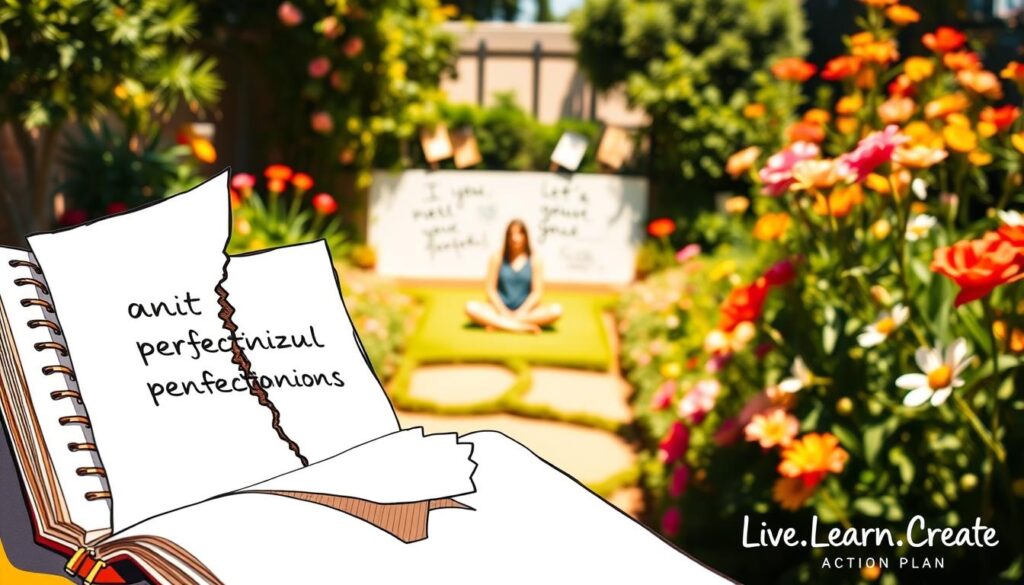
Setting Imperfect Goals
Carmen Galloway’s “Wobbly Goals” framework changed my approach. Instead of fixed targets, it uses buffer systems:
- Goals have 20% flexibility (“I’ll exercise 3-5 days weekly”)
- Three-tiered success metrics (minimum, target, stretch)
- Built-in “experimentation windows” for adjustments
This adaptation of SMART goals acknowledges life’s unpredictability. A Stanford study found flexible planners achieve 32% more long-term success than rigid perfectionists.
“Your plan should be a compass, not shackles. Course-correcting isn’t failure—it’s wisdom in action.”
Tracking Progress Without Self-Judgment
Carmen’s “Growth Wave” method replaces harsh metrics with compassionate observation:
- Weekly “temperature checks” (energy/fulfillment ratings)
- Color-coded tracking (green = growth, yellow = learning, red = needs adjustment)
- Quarterly reviews focusing on patterns, not perfection
I keep a “Failure Budget”—allocating 15% of attempts for experimental learning. This reframes mistakes as research investments rather than shortcomings.
| Traditional Tracking | Growth Wave Method |
|---|---|
| Binary success/failure | Progress spectrum |
| Fixed metrics | Adaptive indicators |
| Self-criticism focus | Curiosity focus |
Your plan becomes powerful when it honors the steps you take—not just the finish line. Start small today, adjust often, and watch your future unfold with more ease than perfection ever allowed.
Conclusion: Embracing Your Beautiful Imperfections
There’s profound beauty in the cracks—just like Japanese kintsugi art celebrates broken pottery mended with gold. Your journey isn’t about achieving flawlessness, but learning to treasure the unique patterns of your experiences.
As Carmen Galloway teaches, true growth happens when we stop waiting for perfect conditions. Mindvalley’s community stories prove this daily—real transformation blooms in the messy middle.
Your life becomes richer when you measure success by courage shown, not mistakes avoided. The resources we’ve shared offer practical growth tools, but the real work happens in your daily choices.
Join our community of recovering perfectionists—where “good enough” is celebrated. Your future self will thank you for beginning today, exactly as you are.
FAQ
How does perfectionism actually hold me back?
Striving for flawlessness often leads to procrastination, burnout, and missed opportunities. When we fixate on perfect outcomes, we delay starting projects, overwork simple tasks, and miss the joy in progress.
What’s the difference between healthy striving and harmful perfectionism?
Healthy striving focuses on improvement with self-compassion, while perfectionism demands error-free performance. The first energizes you, the second drains you with impossible standards.
Can perfectionism really cause anxiety?
Absolutely. The constant pressure to meet unrealistic expectations triggers stress responses in the brain. Studies show perfectionists experience higher cortisol levels and lower life satisfaction.
How do I know if I’m being perfectionistic versus just thorough?
Ask yourself: Is this extra effort adding real value? Perfectionists often polish beyond what’s needed, while thorough people know when “good enough” serves the purpose.
What’s the fastest way to break the perfectionism habit?
Try the “done is better than perfect” approach. Set firm deadlines, share unfinished work, and notice how the world doesn’t end. Small wins build confidence in imperfection.
Where can I find practical tools to overcome perfectionism?
Carmen Galloway’s books at Barnes & Noble and courses on Udemy offer step-by-step methods. Her work blends neuroscience with actionable strategies for lasting change.
How do perfectionists handle mistakes without self-criticism?
Reframe errors as data points, not failures. Ask: “What can I learn?” instead of “Why did I mess up?” This builds resilience and keeps you moving forward.
Can mindfulness really help with perfectionist tendencies?
Yes. Breathing exercises interrupt negative thought spirals, while grounding techniques bring you back to the present moment—where real progress happens.

Transform your home into a more peaceful and mindful sanctuary. Creating a Zen-inspired home environment is a core part of the “Live.Learn.Create” theme, focusing on peace, mindfulness, and a clutter-free space. Here is a curated list of Zen home items.
The Zen Essentials
These items are the building blocks of a calm, intentional living space.
- Candles & Scents:
- Scented Candles: Look for calming, natural scents like sandalwood, lavender, white tea, or bergamot. Choose candles made with soy or beeswax for a clean burn.
- Essential Oil Diffusers: A minimalist, sleek diffuser made of bamboo, ceramic, or glass.
- Essential Oil Sets: Look for blends specifically for relaxation, focus, or sleep.
- Incense & Burners: Natural incense sticks (e.g., palo santo, sage) with a simple, elegant burner.
The Zen Decor
This is about incorporating natural elements and simple design.
- Natural Materials:
- Wood or Bamboo Trays: For organizing candles, stones, or other small items.
- Ceramic Vases: Simple, unglazed ceramic vases in neutral colors like white, beige, or gray.
- Minimalist Art: Simple line drawings, abstract prints, or nature-inspired artwork.
- Hand-Carved Stone Coasters: Or other small stone sculptures.
- Textiles:
- Linen or Cotton Throws: A soft, neutral-colored throw blanket to add warmth.
- Jute or Sisal Rugs: These add natural texture and grounding to a space.
- Meditation Cushions (Zafu) & Mats (Zabuton): These provide comfort for meditation and add a serene touch to a room.
The Zen Ambiance
These items help create a peaceful sensory experience.
- Lighting:
- Himalayan Salt Lamps: These provide a warm, soft glow.
- Japanese-style Paper Lanterns: For a soft, diffused light source.
- Dimmable Smart Bulbs: To easily control the warmth and brightness of your lighting.
- Sound:
- Tabletop Water Fountains: The gentle sound of running water is incredibly calming.
- Wind Chimes: Made from natural materials like bamboo or metal for a soft sound.
- Bluetooth Speakers: Small, aesthetically pleasing speakers for playing ambient or meditation music.
- Nature:
- Bonsai Trees or Air Plants: Low-maintenance indoor plants that bring life and a touch of nature indoors.
- Zen Gardens: A small, tabletop sand garden with a rake and stones for a meditative ritual.
- Decorative Rocks & Pebbles: For bowls or as a decorative element.
Best Sellers https://amzn.to/3Vet1tI
New Releases https://amzn.to/4mwLjTi
Amazon Movers & Shakers https://amzn.to/4fPsZlP
Mindfulness Coloring Books https://amzn.to/4fQ0wMx
Personal Growth Coloring Books https://amzn.to/4lJeRf0
Health & Wellness https://amzn.to/4oRt24C
Zen Home Decor https://amzn.to/3VeA3i6
Zen Garden Decor https://amzn.to/4mXjT8D
Zen Garden https://amzn.to/3HQTVVB
- Mindfulness & Meditation:
- Physical Wellness:
- Habit & Productivity Tools:
- Books:
- Best-selling personal development books (Mindset, The 7 Habits of Highly Effective People, The Subtle Art of Not Giving a F*ck)
- Books on a variety of skills (coding, photography, writing.)
- Educational Gadgets:
- Smart pens that digitize notes (e.g., Rocketbook)
- Portable scanners for digitizing documents
- Laptops, tablets, and accessories
Create (Creativity, Innovation, Projects)
These products cater to your creative side, whether you are a artists, writer, or DIY enthusiasts.
- Creative Supplies:
- Adult coloring books or “paint-by-sticker” books
- Craft kits (e.g., candle-making, pottery, embroidery)
- Digital Creation Tools:
- General Inspiration & Making: